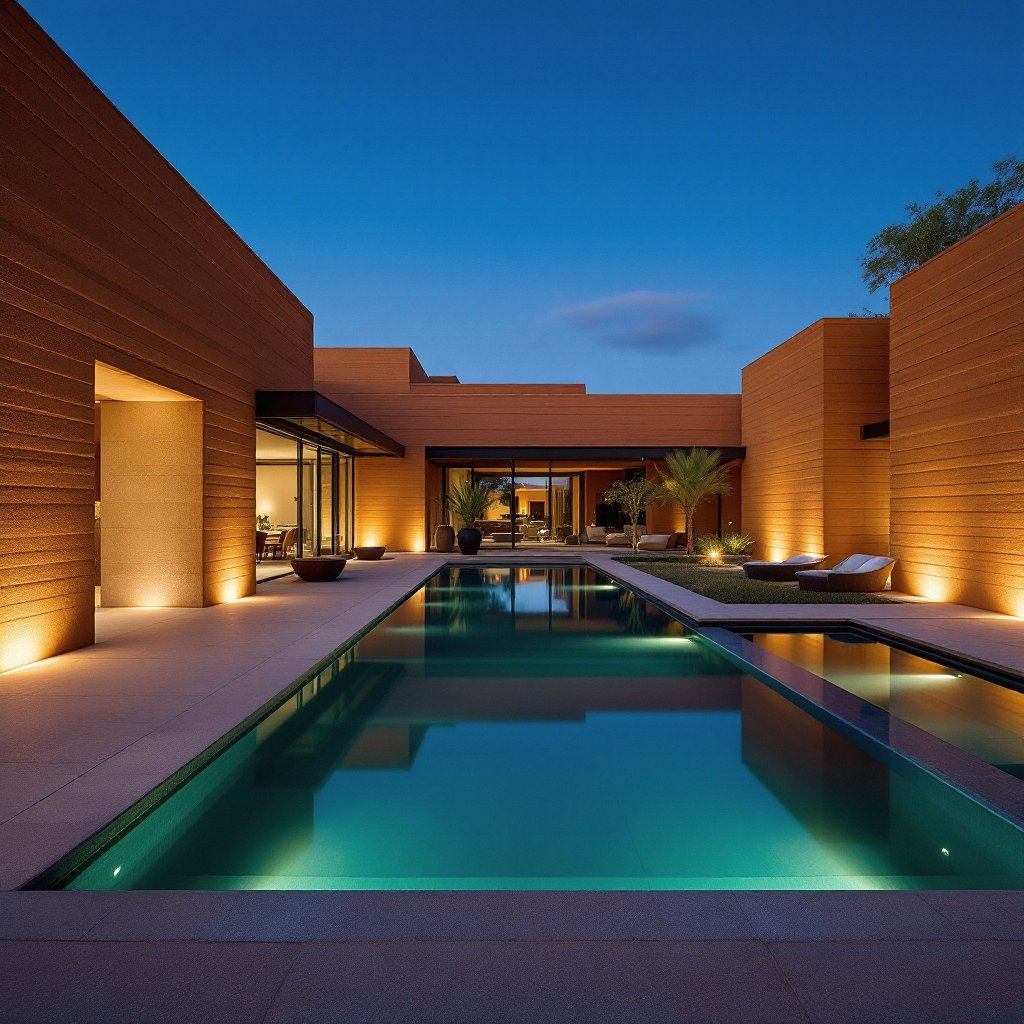
Paradise Valley is estate ground wrapped around mountains, in the state where modern American rammed earth grew up. We build mass-wall homes engineered for Sonoran heat and monsoon rain. From $1M.
Request a Consultation Call (307) 217-5491← Back to our Arizona service area
Because it was already here. Arizona is the closest thing the United States has to a rammed earth homeland: the Sonoran and high deserts have been building in compacted earth and adobe since long before the state existed, and the modern American revival of the technique has been driven for decades by Arizona builders working in exactly this climate. A rammed earth wall in Paradise Valley is not an imported European curiosity. It is the local material, done at estate scale.
And the town itself is unusually well suited to it. Paradise Valley is a residential municipality wrapped around mountains, Camelback to the south, Mummy Mountain at its center, the Phoenix Mountains along the northwest, with the buildable ground running out toward the flanks and washes between them. It is a place where the topography is the amenity, where hillside development is governed with real seriousness, and where the houses that age well are the ones that sit down into the desert rather than perch on top of it. Compacted, stratified earth in a range of ochres and irons is the one wall system that reads as continuous with a Camelback sandstone face rather than as an object placed in front of it.
Paradise Valley is a low-density town of large lots surrounded on all sides by Phoenix and Scottsdale, which means its land supply is fixed in the most absolute way land supply can be fixed: there is no annexation left to do. What trades is what already exists. That produces the pattern we build for, which is teardown-and-rebuild on established parcels and the occasional remaining view lot on a mountain flank, both of them projects where the buyer is not making a five-year bet.
The design culture here is also the right one for this material. The valley's architectural inheritance runs through mid-century desert modernism and the long shadow of Taliesin West a few miles northeast, a tradition built on horizontal masses, deep shade, and materials that came out of the ground nearby. Clients in that lineage do not need to be convinced that a heavy wall is a virtue. They usually arrive already knowing it and asking who can actually build one.
The desert asks the opposite of what a Wyoming winter asks, and that changes the assembly. In a cooling-dominated climate, thermal mass is not a supporting argument for rammed earth. It is the headline. A twenty-inch mass wall does not resist heat the way an insulated stud wall does; it absorbs it, holds it, and releases it out of phase with the outdoor swing. In a place where a summer day can run forty degrees Fahrenheit hotter than the night that follows it, that time lag is worth more than an R-value on a datasheet, because it moves the peak load off the hottest hours entirely.
Our detailing here leans into that. Mass walls take the east and west elevations, which are the exposures that punish desert houses, and the long faces open to the south under overhangs sized to cut summer sun and admit the low winter angle. Deep reveals at every opening are structural honesty and shade device at once: a two-foot wall thickness puts every pane of glass into its own permanent shadow for most of the day. Roof overhangs run generous, both for shade and because the desert's real threat to earth walls is not the heat, it is the monsoon, arriving sideways in July and August in short violent bursts. Good boots and a good hat still govern: stem walls that keep earth clear of splash and sheet flow, grading that assumes the wash will run, and stabilizer content tuned for driven rain rather than for freeze-thaw.
On stabilization we go light here relative to our four-season markets, because the climate does much of the durability work for us. That restraint matters. Cement is where an otherwise very low-carbon wall picks up almost all of its embodied carbon, so using only what the exposure genuinely needs is both the greener answer and the cheaper one. The reasoning is laid out in full in our piece on how much cement a wall really needs.
Clients almost always ask about the strata before they ask about anything else, and in Arizona the answer is unusually good. The color of a rammed earth wall is the mineral content of the soil that went into it, chiefly iron in its various oxidation states, which is the same chemistry that gives this region its reds, rusts, ochres and buffs. Desert soils here tend to deliver a rich palette without additive pigment, and where a design wants a particular banding rhythm we build it by sequencing lifts of different blends rather than by coloring a uniform mix.
That is a real distinction and worth understanding before you look at anyone's photographs. A wall whose strata come from actual differences in the material is a geological object. A wall whose strata come from oxide added to an otherwise identical mix is a decorated one. Both can be beautiful. Only one of them is doing the thing that made you want the wall. We work from the site's own ground and regional blends wherever the engineering allows, and we tell you plainly when it does not.
Two things surprise people who move into one. The first is acoustic. Mass stops sound the way it stops heat, by sheer inertia, and a house with earthen spine walls is quieter than its occupants expect, which matters more than it sounds on lots that back to arterials or sit under an approach path. The second is maintenance, or rather the absence of it. There is no siding to replace, no stucco to recoat on the usual cycle, no paint. The wall's finish is the wall. Detailed correctly at the top and bottom, an earthen wall in this climate asks for inspection rather than intervention.
The third thing, which people do not usually think to ask about until later, is fire. A rammed earth wall is mineral all the way through. There is no fuel in it and nothing for flame to spread across. In a state that has learned hard lessons about wildland fire at the urban edge, that is not a marketing line; it is a material property with real consequences for what survives. We have written about what it does and does not buy you in our piece on rammed earth and wildfire.
A meaningful share of the remaining opportunity in Paradise Valley sits on sloped ground, and hillside parcels here come with design review, disturbance limits and grading scrutiny that catch unprepared teams late. Rammed earth is, counterintuitively, a good citizen in that process. A low, horizontal, earth-toned mass building is usually an easier thing to get through a hillside review than a tall reflective one, because the objections such reviews exist to raise (visual prominence, cut and fill, glare, silhouette against the mountain) are exactly the objections a heavy earthen building does not provoke.
What hillside ground does demand is early engineering. Retaining, foundation stepping and access for a compaction crew all have to be resolved before anyone talks about strata color. We front-load that work, because on sloped desert lots the site is the schedule.
We take projects across Paradise Valley proper and the adjoining estate corridors: the Camelback and Mummy Mountain flanks, the Cheney and Casa Blanca corridors, Clearwater Hills, and outward into the neighboring north Scottsdale and Arcadia-facing markets where the same buyer and the same geology apply. Our Scottsdale, Phoenix, Sedona and Tucson pages cover the rest of the state.
Turnkey rammed earth here runs in the same band as the rest of our residential work, with a $1M residential minimum, and Paradise Valley projects tend to sit comfortably above that floor because the lots and the programs are what they are. Timelines run longer than conventional construction and we say so early: soil testing and mix development, engineering, permitting and hillside review where applicable, then a wall program that proceeds in lifts at the pace compaction actually allows. The full accounting is on our cost guide and, line by line, in this breakdown.
If you own ground in the valley, or are about to, the most useful next step is a conversation about the specific parcel. Bring the address. The soil under it is the first thing we would want to talk about, because in this material the ground is not a site condition. It is the specification.
