Banks fund what they can underwrite, and underwriting runs on documentation. Here's how earthen homes clear lending, appraisal and insurance, in practice, not theory.
Rammed earth estates finance through the same instrument as any luxury custom build: a construction-to-permanent loan drawing against milestones, converting to a mortgage at completion. What lenders scrutinize is certainty, not material novelty, and certainty is deliverable: stamped structural engineering, a fixed-scope contract with a licensed builder, a milestone draw schedule tied to inspectable stages, and a detailed budget. Private banks and regional lenders comfortable with seven-figure custom construction handle these files routinely; the material conversation lasts about as long as the engineer's stamp takes to read.
The appraisal problem, solved with paper
The honest friction: comparables. Most markets have no recent earthen sales, so appraisers lean on cost-basis valuation plus adjusted luxury comps. We arm that process: complete cost documentation, the engineering package, our provenance dossier, and the national record of earthen sales where premiums are visible. Appraisals on documented builds come back workable; the horror stories belong to undocumented ones.
Insurance: the surprisingly good news
Underwriters price risk, and mineral walls remove some big ones: non-combustible construction in an era of wildfire-driven repricing, extreme wind and impact resilience, and no rot, mold-in-walls or termite exposure in the mass itself. Carriers writing high-value homes respond to the documentation package with normal-to-favorable terms, and wildfire-interface builds sometimes do better than framed equivalents. Bring the test records; leave with a quote.
Structuring the build budget
Land first, cleanly, lenders prefer owned, unencumbered land entering a construction loan; it also anchors the appraisal.
Design before debt, carrying design and engineering as owner-funded pre-development produces the documents that make the loan easy; you're buying certainty before you rent money.
Milestone honesty, draws tied to completed stages protect both sides; our schedules arrive bank-ready.
Contingency inside the loan, sized realistically at application beats supplemental requests mid-build, every time.
How does a construction-to-permanent loan actually work, step by step?
The instrument sounds exotic and isn't: one closing, two phases. Here's the whole arc, in order:
1. Pre-qualification. The lender sizes your borrowing capacity against income, assets and the land. Do this before design gets expensive: it sets the ceiling everything else respects.
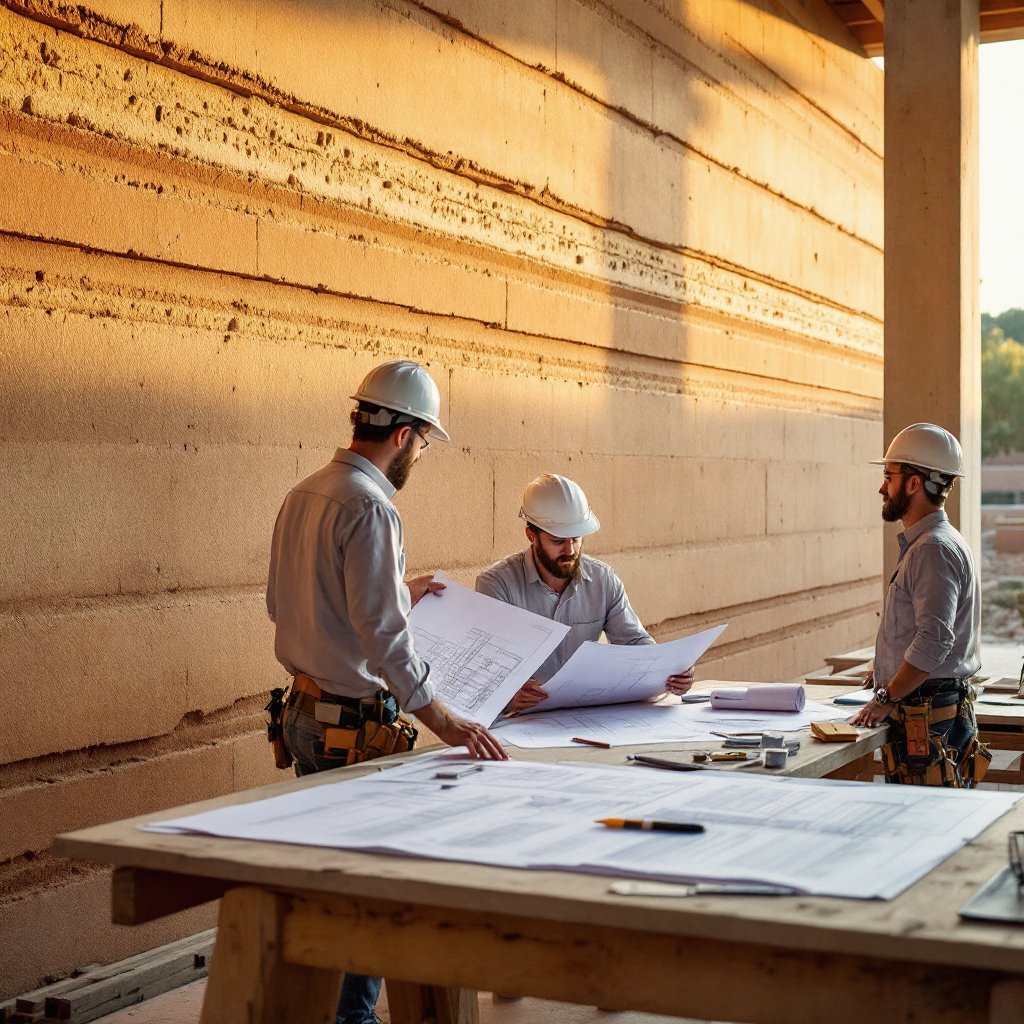
2. The application package. Plans, the fixed-scope construction contract, the line-item budget, the draw schedule and the builder's credentials go to underwriting together. This is where documentation does its work: a complete file moves, a thin one stalls.
3. Appraisal. The appraiser values the future home from plans and budget, "subject to completion." More on strategy below, because this is the step that rewards preparation most.
4. Closing. A single closing covers both phases. During construction you typically pay interest only on the funds actually drawn, not the full commitment.
5. Draws. Money releases against completed milestones (foundation, walls, dry-in, mechanical, finish) each verified by a lender's inspection before funds move. Rammed earth maps cleanly onto this rhythm: struck, finished walls are the easiest milestone an inspector will ever verify.
6. Conversion. At completion the loan converts to a conventional mortgage on the pre-agreed terms. No second closing, no re-qualification gauntlet, no refinancing scramble.
What exactly do we hand your lender?
Piece by piece, the package that turns "unusual construction" into "well-documented file":
Stamped structural drawings, the wall system engineered and sealed for your jurisdiction.
Geotechnical report and soil lab results, sieve, Proctor and Atterberg data plus the written mix design, showing the walls are engineered from the dirt up.
Compressive strength records, test results demonstrating the stabilized mix performs in the 750–2,500 PSI range the structural design assumes.
Fixed-scope construction contract, licensed builder, defined deliverables, no open-ended exposure for the bank.
Line-item budget and draw schedule (every dollar mapped to an inspectable stage.
Builder credentials and insurance certificates) licensing, general liability, builder's risk.
Specification book, assemblies, finishes and systems, so the appraiser prices what's actually being built rather than a generic luxury shell.
The provenance dossier, the material's performance record, maintenance profile and sales precedent, written for an underwriter's eyes rather than a magazine's.
Lenders don't fear earth. They fear blanks. This package has none.
How do appraisal strategies work when there are no comps?
Two methods carry the file. The cost approach values the home as land plus documented construction cost, less depreciation, and a new custom build has essentially none. Our line-item budgets are formatted to feed this method directly, which is a large part of why documented projects appraise workably. The comparable-adjustment logic supplements it: the appraiser starts from the nearest luxury custom sales and adjusts for the earthen envelope the way any premium assembly gets adjusted, supported by the national record of earthen sales we supply. Then the quiet, legitimate craft: encourage the lender to assign an appraiser experienced in luxury custom work, deliver the package before the site visit, and resolve the valuation conversation in the same meeting as the draw schedule. Low appraisals are a documentation failure far more often than a material one.
How should you shop for insurance on a rammed earth home?
Start with carriers that write high-value custom homes: their underwriting is human, not just an intake form. Then ask the questions that route your file correctly:
"How do you classify non-combustible masonry construction?" Rammed earth belongs in the masonry, fire-resistive class, which generally treats the premium kindly. If the representative can't answer, you're at the wrong desk, not the wrong material.
"Is replacement cost based on my documented build cost?" Hand over the budget so the dwelling limit reflects specialist reconstruction, not a per-square-foot table built for framed houses.
"Have you written earthen or masonry custom homes before?" Precedent shortens everything that follows.
"How is wildfire exposure priced?" In interface zones, a mineral wall with defensible site design is an argument in your favor, and some carriers now price it that way. Make them say how.
What will your lender ask? A working FAQ
Is rammed earth even an eligible construction type?
Yes. It underwrites as engineered masonry construction backed by stamped structural documentation. The question usually means "I haven't seen one before", which is exactly what the package answers.
What happens if the builder can't finish?
The same protections as any custom build: a licensed contractor under a fixed-scope contract, builder's risk coverage, and draws that release only against completed, inspected work. The bank never funds ahead of the wall.
How are draws verified on an unusual wall system?
More easily than most. A rammed earth milestone is visible from the driveway: the walls are either standing, struck and finished, or they aren't. Inspectors appreciate the clarity.
What if the appraisal comes in low?
The standard remedies apply, more equity, a challenge supported by the cost documentation, or a second appraisal. The honest answer, though, is prevention: files that arrive with complete cost and engineering documentation rarely meet the problem.
Can land I already own count toward equity?
Typically yes, owned, unencumbered land usually enters the deal as equity, which is one reason we recommend settling the land before renting the money.
Will the loan cost more because the house is unusual?
Rate sheets price the borrower and the loan-to-value, not the wall. What novelty actually costs is time in underwriting, and time in underwriting is precisely the tax the documentation package was built to waive.
Banks fund certainty. A finished, documented estate is the easiest collateral an underwriter sees all year.
What are the most common financing mistakes, and how do you avoid them?
The failures we see are rarely about the material. They're about sequence:
Shopping lenders with nothing in hand. Calling a loan desk to ask "do you finance rammed earth?" invites a reflexive no from someone reading an intake script. The same institution says yes to a complete package. Lead with documents, not vocabulary.
Designing past the pre-qualification. A plan that outruns the borrowing ceiling forces painful redesign at the worst possible moment. Fix the number first; let the architecture respect it.
Treating the appraisal as a formality. It's the load-bearing step. Feed it early, feed it well.
Sizing contingency optimistically. A realistic contingency inside the loan at application beats a supplemental request mid-build, every single time.
Leaving insurance until closing week. Carrier conversations run in parallel from the start, so the binder is ready when the loan is.
None of this is exotic. It's the ordinary discipline of luxury construction finance, applied to walls that happen to outlast the mortgage by a century or two.
No dedicated lenders, nor needed. Any institution fluent in luxury custom construction can underwrite a documented earthen build; we've supplied the documentation to make that conversation short.
Can VA or conventional conforming loans work?
Construction lending for seven-figure customs typically runs jumbo/portfolio rather than conforming. Program specifics change; our lane is producing the documentation any program requires: your lender or ours can speak to current products.
What kills earthen financing deals?
The same things that kill any construction loan: no stamps, vague scope, unlicensed builders, fantasy budgets. The material gets blamed; the paperwork was the culprit.
Does Bighorn offer in-house financing?
We arrange and document rather than lend, and we'll gladly work alongside your banker from the first consultation so the money and the drawings mature together.