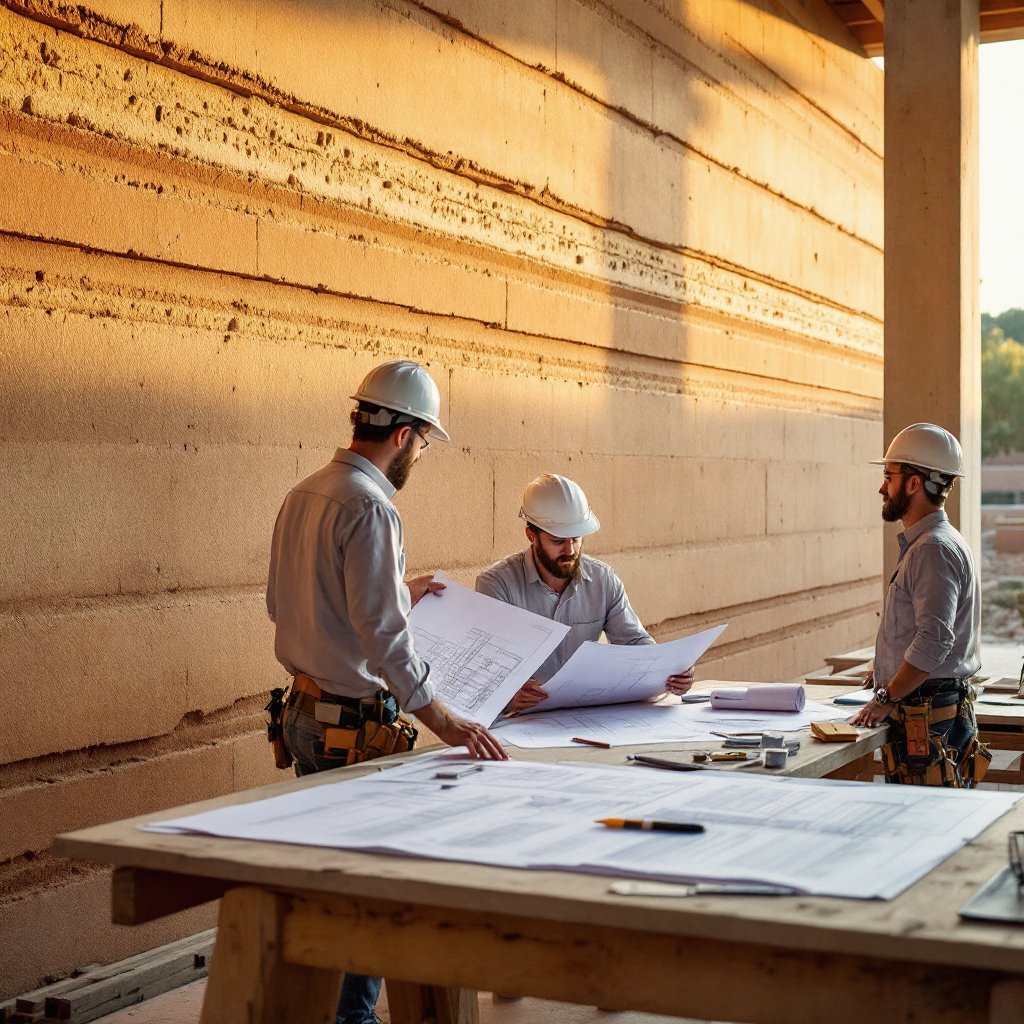
The bighorn ram holds the high country by being built for it, sure-footed, unhurried, impossible to imitate. It seemed like the right standard for houses.
Request a Consultation Call (307) 217-5491A specialist practice building rammed earth homes and commercial earthen walls, led by one of the few operators in the country thoroughly trained in the craft, the soil engineering, the formwork discipline, the compaction technique that separates walls that last centuries from expensive experiments. We work with rammed-earth-experienced architects and engineers on every commission, and we build a deliberately small number of projects each year across Arizona, Tennessee, Kentucky and Indiana.
Bighorn intends to be the definitive American name in rammed earth, the builder of record for the finest earthen homes in the country and the reference resource for everyone learning the material (start at the Learn hub, continue in the Journal). Four states today. The map will grow; the standard won't move.
Every builder claims standards; ours are specific enough to be checked. Three commitments define the practice, and each one costs us something, which is how you know they are real.
Rammed earth is a craft with a narrow margin for improvisation. A framing crew can have an average Tuesday and the house is fine; a wall crew that compacts a lift at the wrong moisture content has built a defect into a monolith. So nobody touches a Bighorn wall on instinct. Every crew member is trained in the specific work in front of them, the soil blend for this wall, the lift heights for this section, the compaction rhythm the mix requires, the joint and embed details on this panel, before formwork goes up. The training happens on mockup panels, not on your house. It is slower and more expensive than hiring generalists and hoping, and it is the single largest reason our walls are worth building at all. The craft has a four-thousand-year record, from the Great Wall's earthen cores to the pisé farmhouses of France still standing after three centuries; every failure in that record traces to someone who skipped the discipline. We choose not to be in that data set.
We take a deliberately small number of commissions each year, few enough that the practice's principal is meaningfully present on every one. The math is unsentimental: our supervision, our trained crews and our mockup-first process do not scale the way a production builder scales, and pretending otherwise is how specialist firms become former specialist firms. Capping the calendar means we sometimes say "next year" to good projects. It also means no Bighorn client has ever been the project that got the B-team, because there is no B-team to get.
Honesty in construction is usually framed as virtue. We treat it as economics. A fixed-scope price built from finished construction documents costs us the ability to play allowance games, and it buys us clients who trust the number, which is worth more. A pros-and-cons page that lists real cons costs us the prospects earth was never right for, and saves both of us a two-year mistake. Telling a client in the first consultation that their budget, site or timeline does not fit costs us a contract and earns us the referral they send later, which in a practice this small is the entire marketing department. Deception has a terrible return profile on a twenty-month project. We simply decline to hold the position.
The bighorn holds the most unforgiving real estate in North America by being built for it, precisely. Hooves structured for rock that would break other animals. A skeleton engineered to absorb impacts that would shatter lesser frames. No hurry, no display, no wasted motion, just an animal so exactly suited to its ground that the ground might as well have designed it. That is the standard we named the practice after: buildings so suited to their site, their soil and their climate that they read as something the landscape produced. There is a second meaning we admit to. Bighorns settle questions of standing with a collision measured in horsepower, and the ram's skull is famously built to deliver and survive it. Our walls are 18 to 24 inches of compacted ground. The metaphor was not subtle, and we did not want it to be.
The phrase appears on this page because clients should know what they are hiring. The operator's competencies behind this practice, concretely:
Bighorn publishes more free rammed earth knowledge than any American builder we know of: the Learn library covers the material, the costs, the honest tradeoffs and the financing realities, and the Journal adds to it every week without exception. This is strategy, not charity, but the strategy is unusual enough to explain. The material's biggest obstacle in America is not physics; it is ignorance, buyers who don't know it exists, lenders who can't price it, counties that have never permitted it. Every one of those knowledge gaps shrinks the market for the thing we love building. So we publish, including the vetting questions a client should ask any earthen builder, questions a competitor's prospect could carry straight into a competitor's office. If those questions disqualify a builder, the client just dodged a half-built wall, the material dodged a reputation wound it would carry for a decade, and the industry's record stays worth defending. A rising standard is worth more to us than a hoarded one.
Clarity cuts both ways, so: Bighorn is not a volume builder, and no schedule pressure will make us one. We are not the cheapest path to an earthen wall, turnkey homes run $250–$450+ per square foot and commissions start at $1M, because the training doctrine and supervision density above are real costs paid on purpose. We are not a fit for clients who want the material's look without its process; the mockup panels, soil testing and engineering are the product, not friction around it. And we are not precious about questions, skeptical clients who have read our own pros-and-cons page make the best building partners we have.
Rammed earth punishes buildings designed as if walls were an afterthought, so we run a collaborative model with sharp edges. Clients who arrive with an architect keep their architect: we join as the earthen specialist (advising on mass placement, opening strategy, panel logic and detailing) while the design vision stays where it belongs. Clients who arrive without one are introduced to architects who have drawn for this material or who want to learn it properly with us alongside. Structural engineering is never negotiable: every Bighorn wall is stamped by engineers experienced with earthen structures, with the calculations and testing documentation that make county reviews a process instead of a debate. The one thing we do not do is build another firm's earthen design without review authority over the wall details, our name cures into every wall we ram, and we warranty what we control.
Arizona, Tennessee, Kentucky, Indiana. The list looks eccentric until you see the design. Arizona is the craft's American home: the market that keeps a builder honest against the deepest bench of earthen precedent in the country. Tennessee, Kentucky and Indiana are the frontier: estate markets with land, wealth and essentially zero rammed earth stock, where the four-season insulated assembly we build is the difference between a desert curiosity and a genuine regional architecture. Depth over sprawl is the operating rule: we would rather be the definitive builder in four states than a logo in forty, because this craft travels badly without its people. Each state gets real operational presence, real county relationships and real soil knowledge, not a landing page and a plane ticket. The map will grow when the standard can travel with it, and not one county sooner.
