
Indiana is home ground for our operations, and wide open for the material. The first serious rammed earth estates in the state are going to define what Midwest earthen luxury looks like.
Request a Consultation Call (307) 217-5491Because nobody else has, at this level, and because the climate case is stronger than people assume. Indiana's continental swings (humid 90s to single digits) are exactly what thermal mass moderates best, and its energy codes are met with insulated-core assemblies that keep pure strata faces on both sides of the wall. For Carmel, Zionsville, Geist and Brown County buyers who have seen every stone-and-timber estate the market offers, a monolithic earth home is the first genuinely new thing in a generation.
Insulated stabilized walls engineered for freeze-thaw, stem walls above grade, snow-country overhang detailing and vapor-open finishes that let the mass breathe and buffer. Bighorn is a Wyoming company and Indiana is a mobilized market for us: a crew, a formwork system and an engineered blend arrive, the walls go up over a defined window, and local trades carry the sitework, mechanicals and interiors. Mobilization is a real line item and we price it openly.
Indiana's continental swings (humid 90s to sub-zero wind chill in the same year) are the four-season wall's toughest local exam, and the assembly answers with the full stack: double-wythe strata faces over continuous insulation meeting zone 5A code, stabilization percentages at the top of our range, stem walls detailed for freeze-heave soils, snow-load-rated overhangs, and vapor-open finishes that let the mass buffer humidity year-round. The payoff is the same physics as everywhere, amplified by contrast: a January evening inside two feet of earth, silent and steady at temperature, while the wind does its work on everyone else's siding.
The north-side estate ring (Carmel, Zionsville, Westfield, Geist) has the lot sizes, budgets and appetite for signature architecture, and a rammed earth commission here would be the most talked-about build in any of those markets the year it rises. Brown County and the Bloomington hills offer the retreat-country sites this architecture loves: elevation, woods, long views and a culture already fluent in organic design. Northern lake country brings waterfront programs; and Indiana's farm estates statewide hold the purest version of the story, walls compacted from the fields around them. Our crews are Indiana-based: this is home turf, shortest mobilization in the practice, and the state where a first mover gets our closest attention.
Indiana's glacial till is a builder's inheritance: well-graded sands and gravels left by the ice sheets, loess silts, and clays that blend rather than dominate. Strata palettes run warm buff, gray-cream and soft umber, quieter than Sedona's reds, perfectly tuned to Midwestern light and limestone. Site soil frequently contributes a meaningful fraction of the blend; the glaciers did the aggregate sorting ten thousand years early.
We know this buyer because we operate among them. The Carmel, Zionsville and Geist estate market is full of people who have already done the expected house (the stone-and-timber build, the lake contemporary, the brick Georgian with the sport court) and who have discovered that the market's top shelf all comes from the same catalog. They are founders and executives who think in decades, families consolidating onto acreage west of Zionsville or along Geist's quieter fingers, and design-literate owners who would rather have the county's one unrepeatable house than its fifth-largest. For them the material's pitch is simple: a monolithic earth estate is the first genuinely new offering in this market in a generation, it performs like the most advanced envelope money can buy, and no one (at any budget) can commission a copy, because no other site shares the ground it was compacted from. Teardown-and-replace parcels in older Carmel and Zionsville sections work as well as raw acreage; the architecture actually benefits from mature trees that new subdivisions cannot sell at any price.
Brown County has been Indiana's argument for organic architecture since the art colony painters arrived a century ago, and it remains the state's best retreat country: wooded ridges, hollow-and-knob topography, long autumn views, and a culture that already prefers buildings that defer to their setting. Rammed earth is the logical next sentence in that tradition. A strata wall set into a ridge reads like the exposed cut of the hill itself; deep window reveals frame the woods the way the colony's painters framed them; and the mass makes a retreat genuinely restful, silent against wind, stable against the ridge-top temperature swings, indifferent to whether anyone visits in February. We design Brown County and Bloomington-hills projects around slope and view axis first: stepped foundations that ride the grade, courtyards cut into the hillside for shelter, glass gathered on the long prospect and earth defending the rest. For Indianapolis families, it is a ninety-minute drive to a different century.
Indiana's glacial story deserves the longer version, because each deposit type gives the wall something different. Till, the unsorted blend the ice sheets dropped in place, is the broad inheritance across central Indiana: sand, gravel, silt and clay already mixed, often needing only modest correction to become structural wall material, with warm gray-buff coloring that suits Midwestern light. Loess, the wind-carried silt laid down along the Wabash and across the southwest, is the palette ingredient: too fine to carry a wall alone, but in measured fractions it smooths the strata's texture and warms the bands toward honeyed buff. Outwash, the sorted sands and gravels flushed from the melting ice into valley trains around the White River and the north's lake country, is the aggregate gift: clean, well-graded structure that a mix designer would otherwise have to buy. Most Indiana parcels hold some combination, which is why our discovery phase digs test pits before anything is drawn. The glaciers did ten thousand years of material prep; we simply grade it, blend it to the 5–10% stabilization the engineering requires, and compact it back into the landscape it came from.
March does its Indiana thing (sixty degrees Tuesday, snow Thursday) and the house declines to participate; interior mass averages the whiplash into a flat, unbothered line. June brings the green humidity and the first real heat, and the insulated core earns its keep: the outdoor swelter stays outdoors while vapor-open interior finishes keep the air feeling dry-clean rather than clammy. August afternoons in the 90s are the show-off weeks (the interior wall face still cool to the palm at 5pm) and October is pure reward, windows open, walls banking warm afternoons against frost-edged nights. Then the lake-effect edge of January: wind chill below zero, furnaces across the county running flat out, and an earth house losing temperature so slowly that a power outage becomes an inconvenience instead of an emergency. A framed house in Indiana argues with the weather twelve months a year. An earth house mostly ignores it, which is the most luxurious thing a Midwestern wall can do.
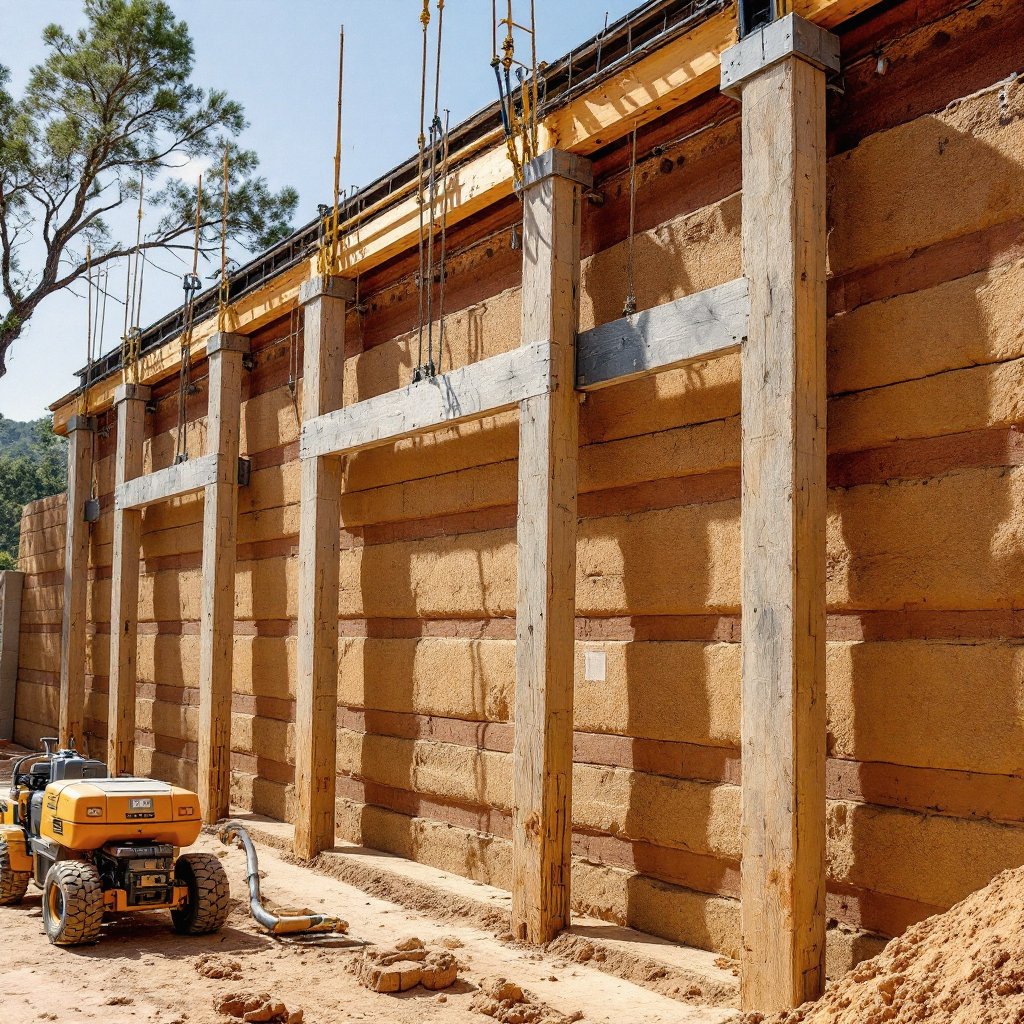
Indiana is where our operations live, and for a first-mover client that is worth spelling out. It means the shortest mobilization in our four-state footprint and supervision measured in site visits per week, not flights per month. It means we already know the region's building departments, inspectors and trade benches (the excavators, concrete crews and finish trades a project this unusual needs to be choreographed around) and we manage the material-education conversations with counties that have never processed an earthen permit, arriving with stamped engineering and precedent documentation so your approval is a process rather than an adventure. It means weather-window agility during wall season, because our people are an hour away when a forecast moves, and it means the year-one review visit actually happens in person. The economics are unchanged (walls 18–24 inches, turnkey from $250–$450+ per square foot, commissions from $1M) but the attention density is the home-field difference. The first serious rammed earth estates in Indiana will define the category for the state, and we intend to be standing next to them, close enough to check on the walls on a Tuesday.
Request a Consultation Call (307) 217-5491
