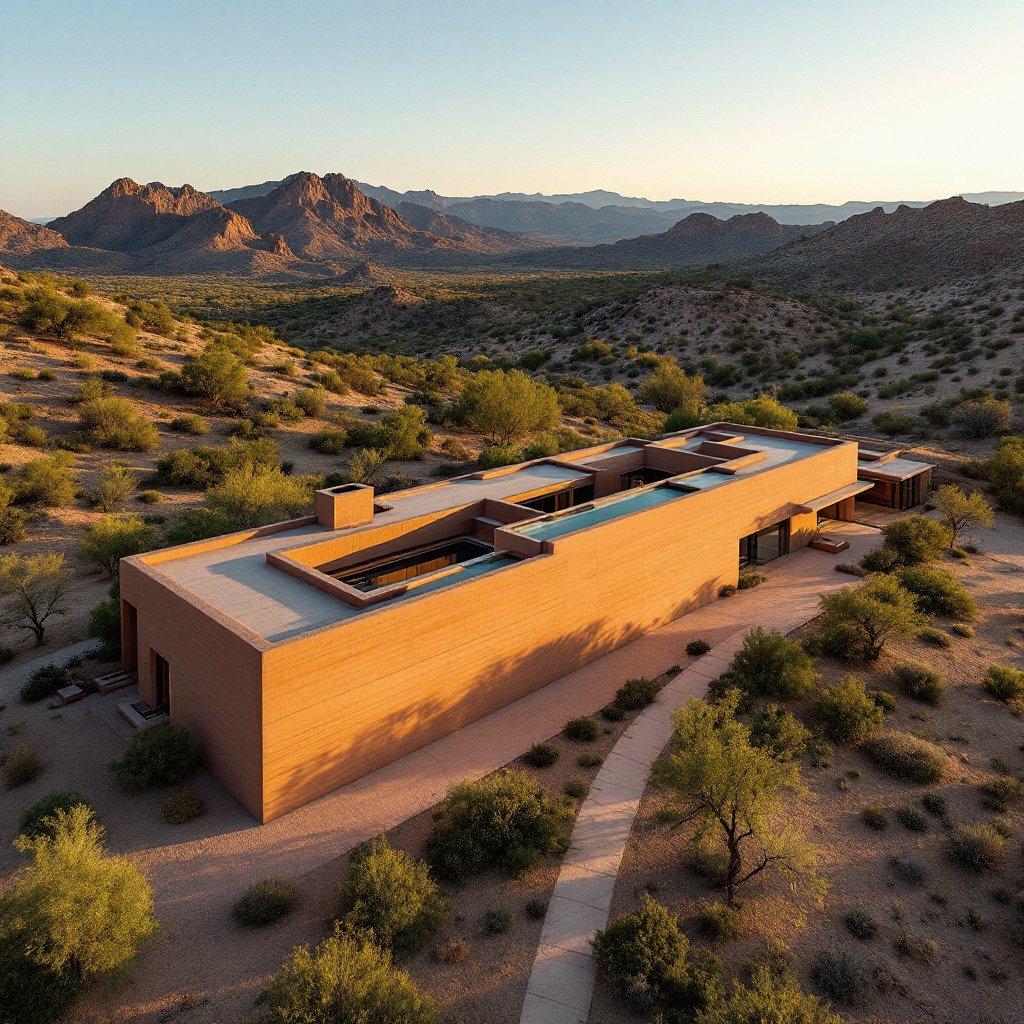
The Catalina foothills, Tanque Verde and the high-desert estate country of the Old Pueblo, the town that made modern earthen building American again. Single-mass Sonoran walls from $1M.
Request a Consultation Call (307) 217-5491← Back to our Arizona service area
Every material has a hometown, and modern American rammed earth grew up here. When the technique re-emerged in this country in the middle of the last century, it was Tucson that took it seriously, architects, engineers and owner-builders in the Old Pueblo rammed real houses out of real Sonoran ground, and those houses did not merely survive. They aged into some of the most quietly coveted homes in the basin, walls mellowing under sixty and seventy summers while the framed subdivisions around them went through their second and third reskinnings. Building rammed earth in Tucson is therefore not pioneering; it is joining a lineage. The precedent stock exists here in a way it exists almost nowhere else in the United States, houses to walk through, walls to put a hand against, a local memory of what the material does across decades rather than seasons.
That inheritance changes the practical texture of a project. Conversations that begin from zero in most American cities begin here from familiarity: reviewers who have seen stamped earthen wall documentation before, tradespeople who understand what a two-foot monolithic wall means for their scope, neighbors who grew up knowing an earth house on the street. And underneath the cultural case sits the physical one: the Sonoran Desert around Tucson is, quite literally, the textbook climate for high-mass construction, the environment the material's modern American chapter was written in. When we tell clients in Tennessee or Indiana that this building system has a proving ground, this is the ground we mean.
Tucson sits near 2,400 feet, a half-step higher and drier-aired than the low desert to its northwest, and that elevation buys the thing thermal mass loves most: a wide daily temperature swing. Through much of the year the gap between the afternoon high and the pre-dawn low runs thirty degrees and more, hot days handing off to genuinely cool nights. An 18-to-24-inch rammed earth wall is a machine built for exactly that rhythm. The wall absorbs the day's heat slowly at its outer face, delays it, dilutes it, and hands the interior a muted average instead of the raw extremes; then the cool night draws the charge back out and the cycle resets. In climates where nights stay hot, mass needs more help. In Tucson, the desert itself does half the mechanical engineering every single evening.
Orientation discipline does the rest. At 32 degrees north the summer sun rides high and is easily excluded with deep overhangs, ramadas and correctly proportioned south glazing, while the low winter sun pours in exactly where mass floors and walls can bank it. West faces (the direction that punishes every desert house) get earth, service rooms and small deep-set openings rather than glass. Monsoon season gets the respect it demands: overhangs and scuppers sized to cloudburst rates, concrete stem walls lifting the earthen wythes above grade and splash line, finish grading that moves stormwater away fast, and breathable water repellents that shed rain while letting the wall exhale vapor. It is the good-boots-good-hat formula, tuned for a desert that saves most of its annual rain for a few violent summer afternoons.
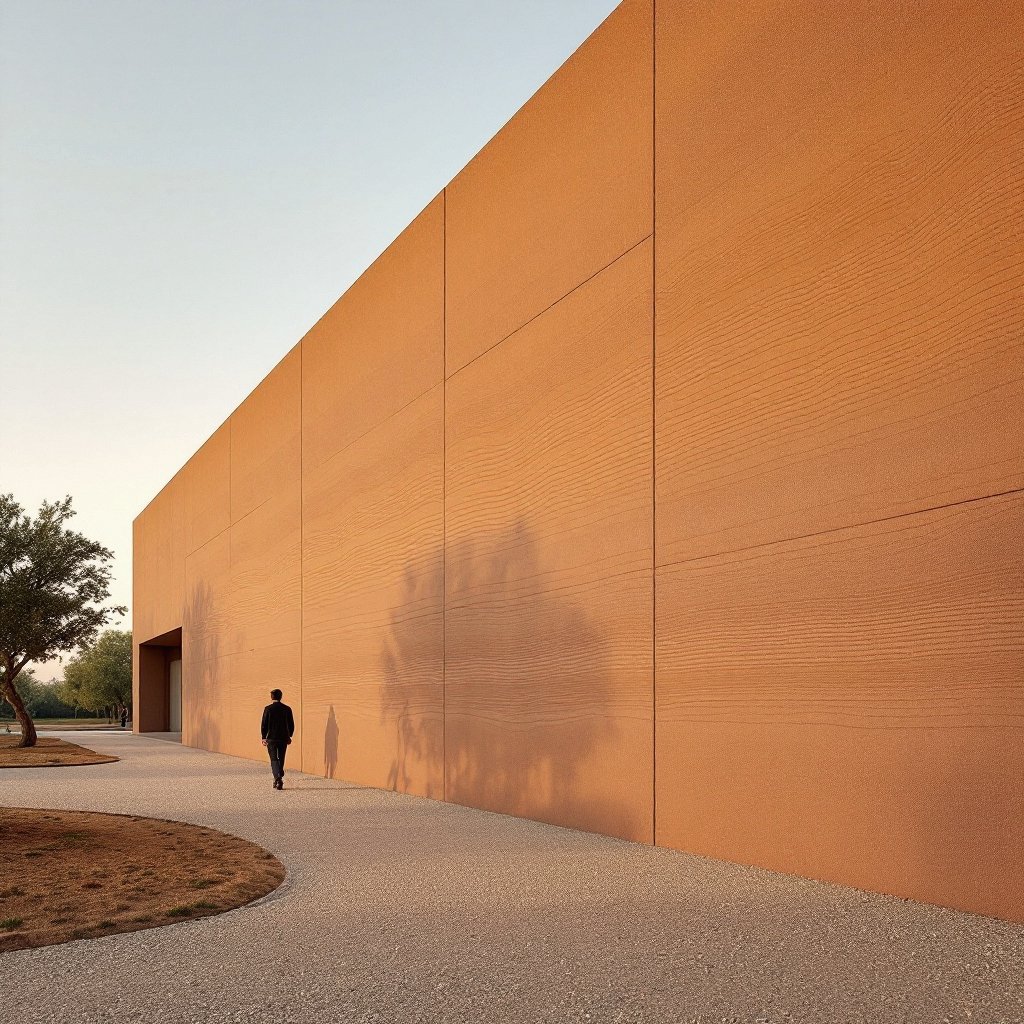
The ground around Tucson is one of the reasons the revival happened here. Off the Catalinas' flanks, decomposed granitic soils bring exactly what a rammer wants, angular, well-graded mineral structure with a quartz-and-feldspar sparkle that catches low sun across a finished face. Down in the basin, the alluvium runs a buff-rose family, warm and quiet, that compacts into banding with the soft gradation of a canyon wall photographed at dusk. Most of our Tucson palettes begin with those two sources: foothills granitics for structure and glitter, basin fines for warmth and color, blended and stabilized with 5–10% cement tuned to the mix and the exposure. Where an owner wants more heat in the wall, iron oxide joins the blend at the mixing stage, laid down course by course the way sediment actually falls. Every parcel gets test pits before design commits to anything, the difference between a good wall and an unforgettable one is often two pits and one oxide decision made early. Commercial and hospitality work across the basin follows the same logic; feature and landscape walls run $50–$225 per square foot of wall face.
Southern Arizona is the deepest pool of earthen-building precedent in the country, and it shows in how projects move. Jurisdictions here have been reviewing engineered earthen construction for decades, adobe, stabilized earth and rammed walls are part of the region's ordinary building vocabulary rather than an exotic exception, and our documentation arrives stamped, calculated and formatted the way local plan reviewers expect engineered custom work to arrive. That said, we treat every approval as earned, not assumed: foothills and mountain-edge parcels frequently carry hillside, ridge or native-plant review layers, and the established estate communities run their own design committees. Our answer to all of them is the same mockup-first process we use everywhere, a physical strata sample panel rammed from the parcel's own blend, put in front of the reviewers, because a real wall section wins rooms that renderings cannot. Insurance conversations start early and tend to go well; a mineral wall contains nothing that burns, which is worth discussing plainly on the brush-adjacent fringes of the foothills and the Tucson Mountains.
| Question | The Tucson answer |
|---|---|
| Wall assembly | Single-mass stabilized walls, 18–24", strata face inside and out; insulated cores optional for owners chasing maximum envelope numbers |
| Stabilization | 5–10% cement content, tuned to foothills granitics or basin alluvium and to exposure |
| Orientation | Long axis east–west; glass south and north; earth and service spaces to the west; night-flush ventilation as a design feature, not an afterthought |
| Timeline | 16–26 months soil test to keys; monsoon and high-summer ramming are scheduled around, not through |
| Budget | Turnkey $250–$450+ per square foot; $1M residential minimum |
The quiet advantage of building in the material's heartland is financial. In most American markets, the first hard conversation on an earthen project is with an appraiser who has never seen one; in Tucson, decades of the mid-century revival and everything built since mean genuine comparables exist, earthen-walled homes that have sold, resold and held their place in the market record. Lenders relax when the comp sheet is real, and Arizona lenders have been closing loans on earth walls longer than almost anyone in the business has been alive. We still prepare every file as if it were the first of its kind (full documentation, engineering, specification and cost breakdown) because that is what a seven-figure construction loan deserves. Our cost guide lays out the real 2026 numbers in detail: turnkey homes at $250–$450+ per square foot, walls at $50–$225 per square foot of face, and a $1M residential minimum that the foothills estate market typically runs well past.
Tucson projects begin the way all of ours do: a conversation about land, program and budget, then test pits, then a physical sample panel rammed from your parcel's own ground before anyone falls in love with a rendering. If you are still shopping for the lot, bring us in early: we will walk candidate parcels in the foothills or out toward Tanque Verde and read orientation, slope, washes, access and soil before you close, because the best Tucson earth houses are chosen at the land stage. And if what you want is the full expression of the material (the estate-scale program our luxury homes practice exists for) there is no better place in America to build it than the town where the modern craft was reborn. Request a consultation and we will start with your ground.
Request a Consultation Call (307) 217-5491
