Moab is red rock country, a high desert with a thirty-degree daily swing and almost no private land left. We build estate rammed earth engineered for both its summers and its winters. From $1M.
Request a Consultation Call (307) 217-5491← Back to our Utah service area
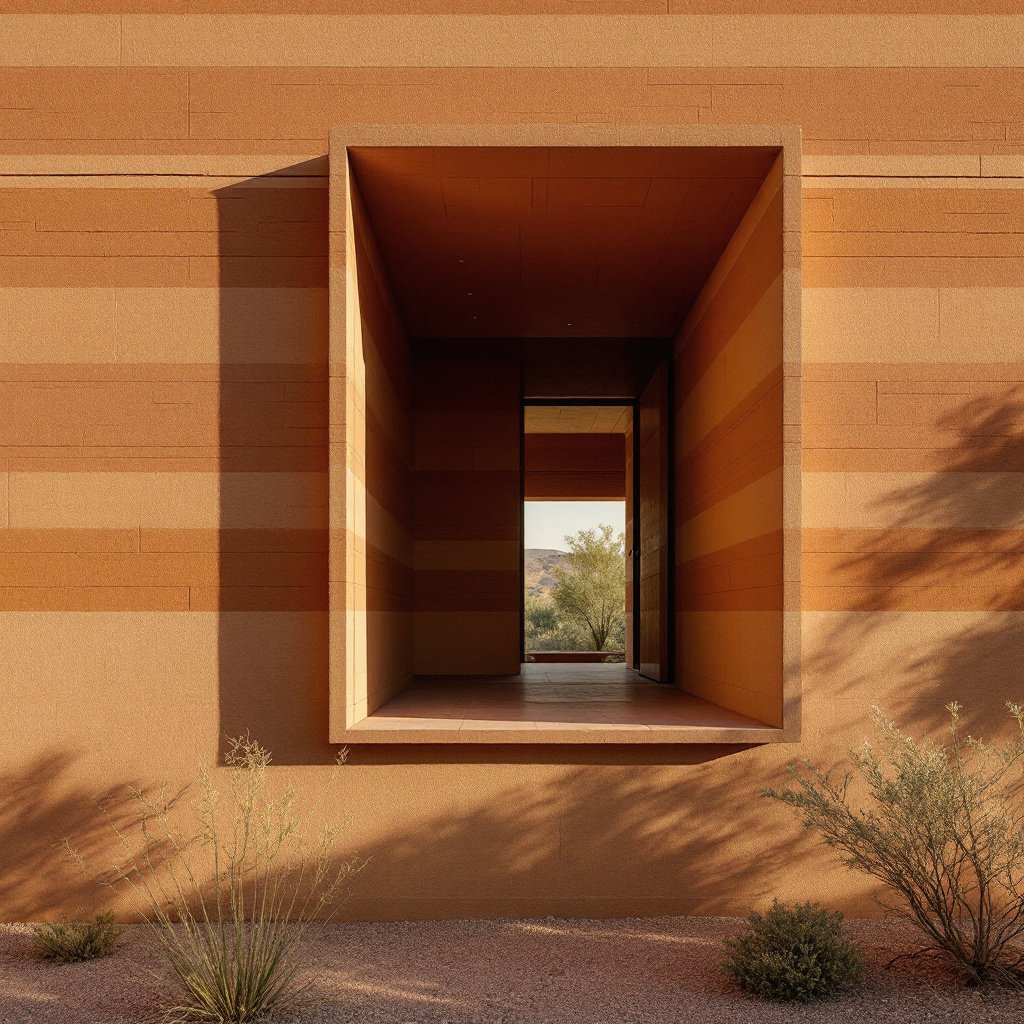
Moab sits in a valley cut through some of the most photographed sedimentary rock in the world. Entrada and Wingate sandstone stand up in cliffs and fins on every side, and what makes them extraordinary is precisely what makes rammed earth extraordinary: visible strata, laid down in horizontal courses, colored by iron. A rammed earth wall is a compressed retelling of the same story in the same palette. There is no other wall system on the market that has this relationship with this landscape, and clients here tend to understand that within about four seconds of touching one.
The practical case is just as strong. Grand County is a high desert at roughly four thousand feet, which means summer heat, cold clear winters, low humidity and an enormous daily temperature swing in both seasons. That swing is the exact condition thermal mass was made for. A heavy wall in a climate with a thirty-degree diurnal range does something an insulated light wall structurally cannot: it flattens the interior curve on both ends, warm in the evening after a cold night, cool in the afternoon after a hot morning, with the mechanical system doing far less arguing.
Almost all of the land around Moab belongs to somebody else permanently: two national parks at the doorstep, national forest in the La Sals, and a vast federal estate in between. Private ground is a thin ribbon through Spanish Valley and along the river corridor, and it does not get any wider. That scarcity is doing what scarcity always does, which is to change what people build. Nobody puts a disposable house on a parcel this hard to acquire.
The buyer profile here is distinct from our ski-country markets. Moab clients are frequently people whose relationship with the landscape is the entire reason for the project, and who care unusually much about how a building sits in it. That produces a brief we are well built for: modest footprint, serious materials, big deliberate openings, and a house that is meant to be there in a hundred years. It also produces a client who asks hard questions about environmental claims, which we welcome, because rammed earth's case survives them when the cement content is kept honest.
Moab is a two-problem climate and the assembly answers both. Summer wants mass and shade; winter wants the wall not to spall. Our detailing therefore runs closer to our four-season practice than our low-desert practice: stabilized mix tuned for freeze-thaw as well as for driven rain, stem walls that lift the earthen wythes well clear of grade and splash, and overhangs generous enough to keep weather off the face year round.
Water here is not an annual average, it is an event. Monsoon season delivers a large share of the year's precipitation in a handful of violent afternoons, and the desert's inability to absorb it is why this country is full of slot canyons. So grading and drainage get designed for the flash, not the average: sheet flow routed away from the wall base, splash zones detailed as if they will be hit hard, and the roof treated as the primary defense it is. The old rule holds everywhere we build, and it holds here with emphasis, good boots and a good hat.
The sun is the other design driver. At this latitude and elevation the light is fierce and the winter sun is genuinely useful, so we size south glazing to let the low winter angle reach the floor and wall mass, then cut the summer angle off entirely with overhang depth. The mass banks that heat and gives it back after dark. It is not a novelty, it is the oldest working mechanical system in the desert, and it is the reason a rammed earth house in this climate tends to surprise people on its utility bills. The full explanation is in our piece on thermal mass.
The hardest brief in this valley is restraint. Every parcel here has a view worth building for, and the failure mode is a house that tries to answer the landscape instead of listening to it: too much glass facing the wrong way, too tall a silhouette on a bench, a palette borrowed from somewhere else entirely. Earthen mass makes restraint easy because it is naturally horizontal, naturally low in contrast against this ground, and naturally quiet.
Our Moab designs tend to run mass walls as the building's spine and its weather shoulder, with the openings concentrated and deliberate rather than continuous. A single two-foot-deep reveal framing a fin of Entrada sandstone does more for a room than a curtain wall does, and it does not cook the room in July. Courtyards work exceptionally well here for the same reason they have worked in desert architecture for several thousand years: an outdoor room enclosed by mass walls is usable at hours when open ground is not, and it gives the house a wind-sheltered center in a valley that gets plenty of wind.
The strata in a rammed earth wall are the mineral record of the soil that made it, and in this country that record is spectacular. The iron chemistry that painted the cliffs is in the ground at their base, so regional blends here tend to produce reds and rusts and buff bands without any pigment added at all. Where a design calls for a specific banding rhythm we build it by sequencing lifts of genuinely different material rather than by tinting one uniform mix, which is the difference between a geological wall and a decorated one. It is worth asking any builder which of those they are selling you.
Two site realities shape Moab projects more than anywhere else on our map. The first is soil: the valley floor and the benches above it vary considerably, and the question of whether we can build from your own ground is genuinely open here rather than rhetorical. We test before we quote, always, and in this country the test result sometimes changes the design.
The second is access and logistics. Moab is a long way from a metropolitan supply chain, and the town's own economy runs hard on a visitor season that congests everything in spring and fall. We schedule material deliveries, crew housing and the compaction program around that reality rather than discovering it in month four. Being candid about timeline is part of the service: a rammed earth build here is a sixteen to twenty-six month proposition from soil test to keys, and anyone promising materially faster has not accounted for this valley.
Earthen construction is not exotic to the American West, but it is unfamiliar to plenty of individual desks, and a project stalls at whichever desk was not prepared. We plan for three of them from day one. The building department wants a structural path it can approve, which means engineering by someone who has stamped mass earthen walls before rather than someone learning on your permit. The lender wants a comparable and an appraisal, which is the single most common place a first-time earth client gets ambushed, and it is why we start that conversation early rather than at draw one. The insurer wants a construction classification it recognizes.
None of these are obstacles once they are anticipated. All three become obstacles when they are discovered in month eight. We handle the sequencing as part of preconstruction and we tell you which conversations you personally need to have, because a lender will listen to a borrower in a way it will not listen to a builder. The detail is set out in our financing and insurance guide, which is worth reading before you make an offer on ground rather than after.
We take projects in Moab and Spanish Valley, out toward Castle Valley and the Professor Valley corridor along the river, up on the benches toward the La Sal foothills, and elsewhere in Grand and San Juan counties where access permits. Our St. George, Park City and Salt Lake City pages cover the rest of the state.
Our residential minimum is $1M, and Moab projects are driven by wall area, formwork complexity and site access rather than by square footage alone, which is why a smaller house here with a lot of exposed mass wall can price above a larger conventional one. Remote sites add logistics cost, and we put that in writing at the start rather than discovering it in a change order. The cost guide sets out the ranges and the line-by-line breakdown shows where the money actually goes.
If you own or are pursuing ground in this valley, bring us the address and we will start where the material starts, with the dirt under it. In this country, more than most, the ground and the building want to be the same color for a reason.
