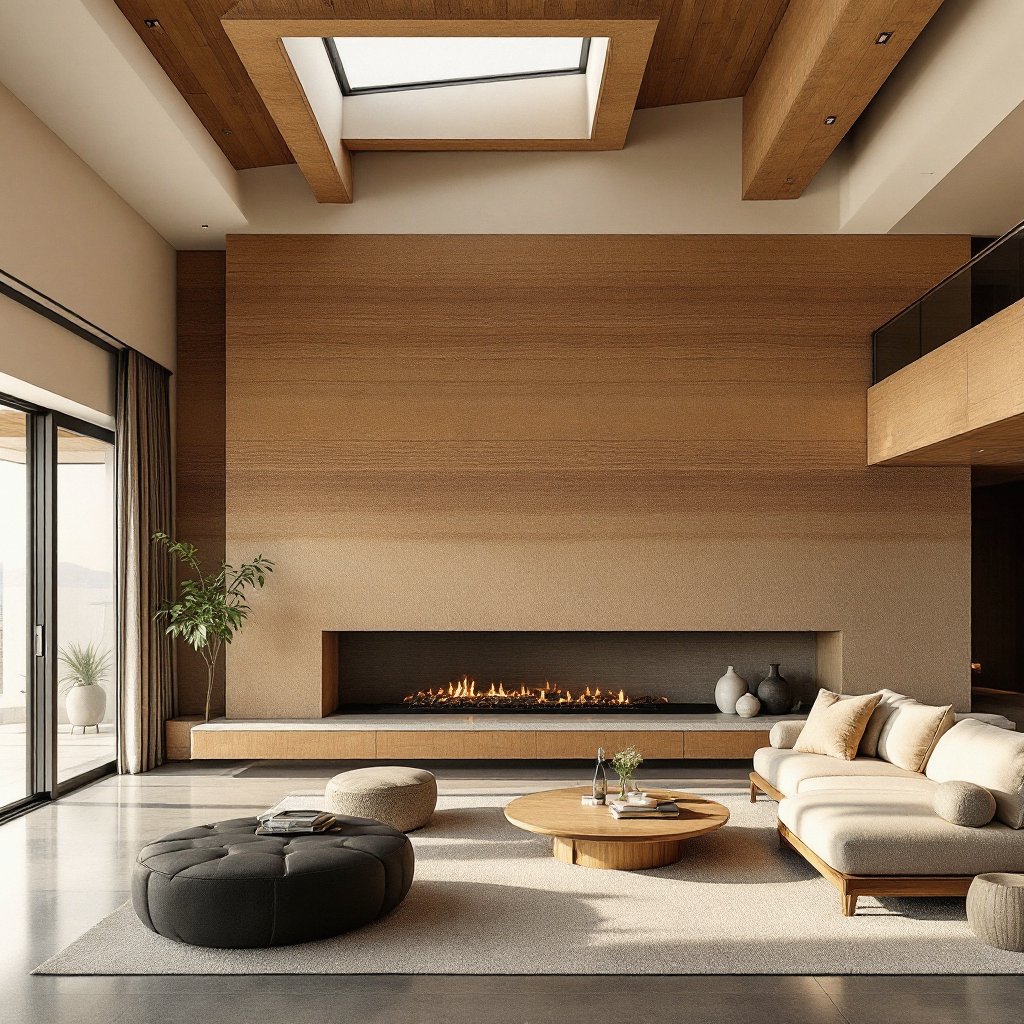
Visitors to rammed earth homes all say the same thing: it feels different in here. That feeling has a name, a mechanism and a utility bill to prove it: here's how thermal mass actually works.
Request a Consultation Call (307) 217-5491Walk into a rammed earth home on a 95-degree afternoon and your body notices before your brain does: the air is unhurried, the surfaces are cool, the light is quiet, and the HVAC (if it's running at all) is whispering. Owners stop noticing after a while. Guests never do.
Thermal mass is the capacity of dense material to absorb, store and slowly release heat. Two feet of compacted earth is an enormous thermal battery: during a hot day the walls absorb heat that would otherwise become indoor temperature; overnight they release it, outward to the cooling air, gently inward when interiors run cooler. The result is a flywheel effect: outdoor temperatures may swing 30–40 degrees while interiors drift a handful.
High-diurnal climates (hello, Arizona) are the material's home game: big day-night swings recharge the flywheel daily. Humid four-season climates play differently (the swings are smaller and winters are real) so our Tennessee, Kentucky and Indiana assemblies put insulation inside the wall: strata faces on both sides, a thermal break in the core. The mass inside the insulation then does its finest work, holding whatever temperature you paid for, hour after hour, in silence.

Smaller mechanical systems, shorter run times, and interiors that never do the afternoon-spike-evening-chill dance framed houses perform daily. Add the humidity buffering of vapor-open walls and you get the phenomenon owners describe with unscientific unanimity: the house feels calm. The physics agrees. See how it compares to concrete, or ask what it would mean on your land.
Three ideas explain everything above, and none requires an engineering degree, just a willingness to think about heat as a slow-moving substance rather than a light switch.
Specific heat and sheer quantity. Every material can store some heat per pound; earth's number is respectable rather than spectacular. What makes the wall extraordinary is the tonnage. Compacted earth runs 120–140 pounds per cubic foot, and a house wrapped in walls 18–24 inches thick carries hundreds of tons of it. Multiply a modest storage capacity by an immodest mass and you get a thermal reservoir so large that a single hot afternoon simply cannot fill it. A framed wall, by contrast, weighs almost nothing; it has no reservoir to fill, so heat that gets past the insulation arrives in the room essentially on schedule.
Thermal lag. Heat doesn't teleport through two feet of dense material; it migrates, and the trip takes hours. A pulse of heat landing on the exterior face at three in the afternoon works its way inward slowly enough that whatever remains of it reaches the interior face late in the night, at which point the outdoor air has cooled, the wall is shedding heat back outward, and the pulse largely reverses course before it ever bothers you. Engineers measure this delay in hours for walls of this thickness. In practice it means the wall answers this afternoon's weather with last night's temperature.
Decrement factor. Lag says heat arrives late; decrement says it arrives diminished. Of the temperature swing striking the outside face, only a fraction survives the journey to the inside face: the rest is absorbed, smeared across time, and re-emitted outward. Picture a crowd's roar heard through a thick stone wall as a murmur: same signal, drastically attenuated. A 35-degree outdoor swing arriving indoors as a two- or three-degree drift is the decrement factor doing its quiet work.
Here's how those three ideas play out across a July day, in the only units owners care about, how the house feels.
6 a.m. The walls spent the night unloading yesterday's heat into cool pre-dawn air. They start the day at their coolest, holding the interior in the low seventies without mechanical help.
Noon. Outside climbs through the nineties. The exterior faces begin absorbing, and the first inches of wall warm, but noon's heat is hours from the interior, and the rooms are still coasting on the walls' overnight reserve. The HVAC hasn't had a real opinion yet.
4 p.m. Peak brutality outdoors. In a framed house this is the afternoon spike: systems roaring, rooms losing anyway. In the earth house, the walls are mid-absorption, soaking up the assault on the owner's behalf. Interior surfaces remain cool to the palm, which lets your body feel comfortable at air temperatures that would read warm elsewhere; radiant comfort is half this material's magic.
9 p.m. Outdoors finally relents. Yesterday's pattern resumes: exterior faces begin dumping their stored heat back into the evening air. What little warmth completed the inward trip arrives now, gently, into rooms that can afford it.
3 a.m. Full discharge. The flywheel resets for tomorrow, having converted a 35-degree outdoor swing into an interior drift you'd need a thermometer to notice.
Winter runs the film in reverse. The insulated-core assembly (more on configurations below) keeps the interior mass inside the thermal envelope, so every ton of it charges to your setpoint and defends it. Sun through south glazing lands on wall and floor mass and is banked instead of overheating the room; when a front knocks the outdoor temperature down twenty degrees overnight, the interior barely files a report, because the furnace's only job is topping up an enormous, already-warm battery. Owners notice it most during power interruptions: hours into an outage, a framed house is cooling fast while an earth house is just getting started on its reserves.
Mass-only. A solid monolithic wall, no insulation layer. In high-diurnal climates (the desert Southwest, where hot days chase cold nights) the daily swing recharges the flywheel constantly and the configuration performs natively, as it has for centuries. In climates with sustained cold, mass alone eventually loses the argument: with no thermal break, week-long cold soaks the reservoir through.
Core-insulated. Two stratified wythes with continuous rigid insulation between, our standard in four-season country. The exterior wythe takes the weather; the insulation breaks the conductive path; the interior wythe, sitting entirely inside the envelope, holds conditioned temperature with all the flywheel behavior described above. True strata on both faces, modern code compliance in the core.
Exterior-insulated. Insulation outside the mass, with a cladding over it. Thermally sound (all the mass ends up inside the envelope) but the cladding hides the very strata you commissioned, which is why it appears in our work mainly where a different exterior finish is wanted anyway. Physics happy, photographer devastated.
Equipment is sized for peak load, and mass exists to shave peaks. When the design-day heat arrives hours late and substantially diminished, the calculated peak drops, and the equipment drops with it, smaller tonnage, running longer and gentler cycles instead of the sprint-and-slump pattern that wears machinery and comfort alike. Smaller equipment costs less, lasts longer, dehumidifies better on long low cycles, and whispers. One honest caveat, because we traffic in those: mass moderates loads but does not abolish them, and in cold climates it is a partner to insulation, never a substitute. Any builder telling you thermal mass replaces R-value in Indiana is telling you they haven't built in Indiana.
There's a second reservoir in the walls that gets less press. Vapor-open earth walls exchange moisture with interior air, absorbing when a muggy August afternoon or a long shower pushes humidity up, releasing when winter heating dries the house out. The walls won't replace mechanical dehumidification in a Tennessee summer, but they flatten the hour-to-hour spikes the same way the mass flattens temperature, and the result is air that feels steady in a way instruments confirm and guests can't explain. Calm, in the end, is the product. The walls are just how we manufacture it.
None of this is theory awaiting a demonstration home; it's the settled physics of every thick masonry building humanity has kept for centuries, updated with insulation science the old builders lacked. The consultation is where the general case meets your specific climate, glazing and floor plan, bring your utility bills from the current house, and we'll talk about what the walls would have done to them.
