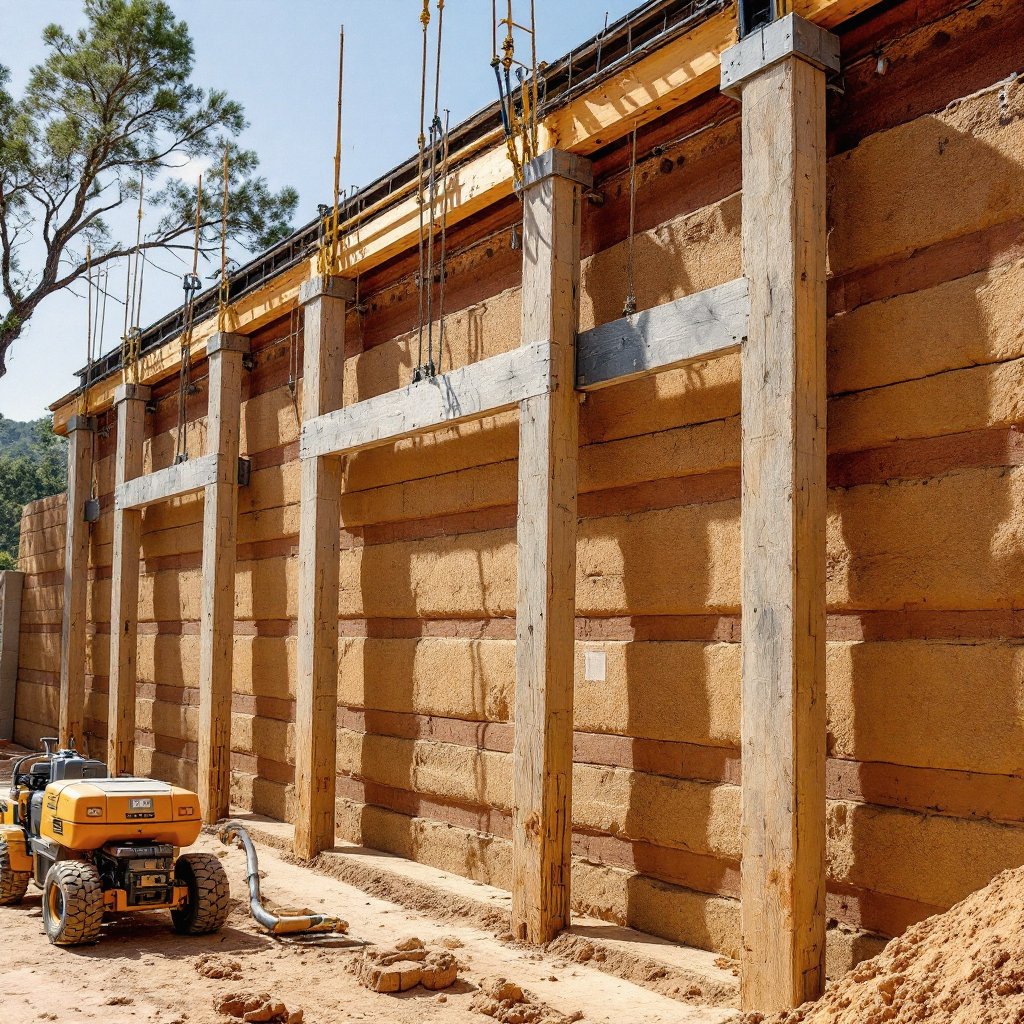
Rammed earth has exactly one enemy, and builders defeated it centuries before building science had a name. The old formula (good boots, good hat) still governs every wall we detail.
Request a Consultation Call (307) 217-5491Ask anyone skeptical about earthen construction and the objection is always water. It rains in Tennessee, the skeptic notes, correctly. So how do walls made of compacted soil last centuries in climates that rot everything else?
The answer predates building science by a few thousand years: good boots and a good hat.
Every Bighorn wall stands on an elevated stem wall, concrete or stone raising the earth above grade, out of splash-back, snowmelt and the occasional hundred-year puddle. Site drainage carries water away before it ever meets the base. Chronic ground moisture is the one condition earth genuinely can't tolerate, so the boots are engineering, not tradition-cosplay.
Deep roof overhangs (the signature look of earth architecture) are the material's umbrella. They keep driving rain off the wall face, shade summer sun off the mass, and make the porches everyone wanted anyway. Vernacular builders didn't draw them for style; the style survived because the physics worked.
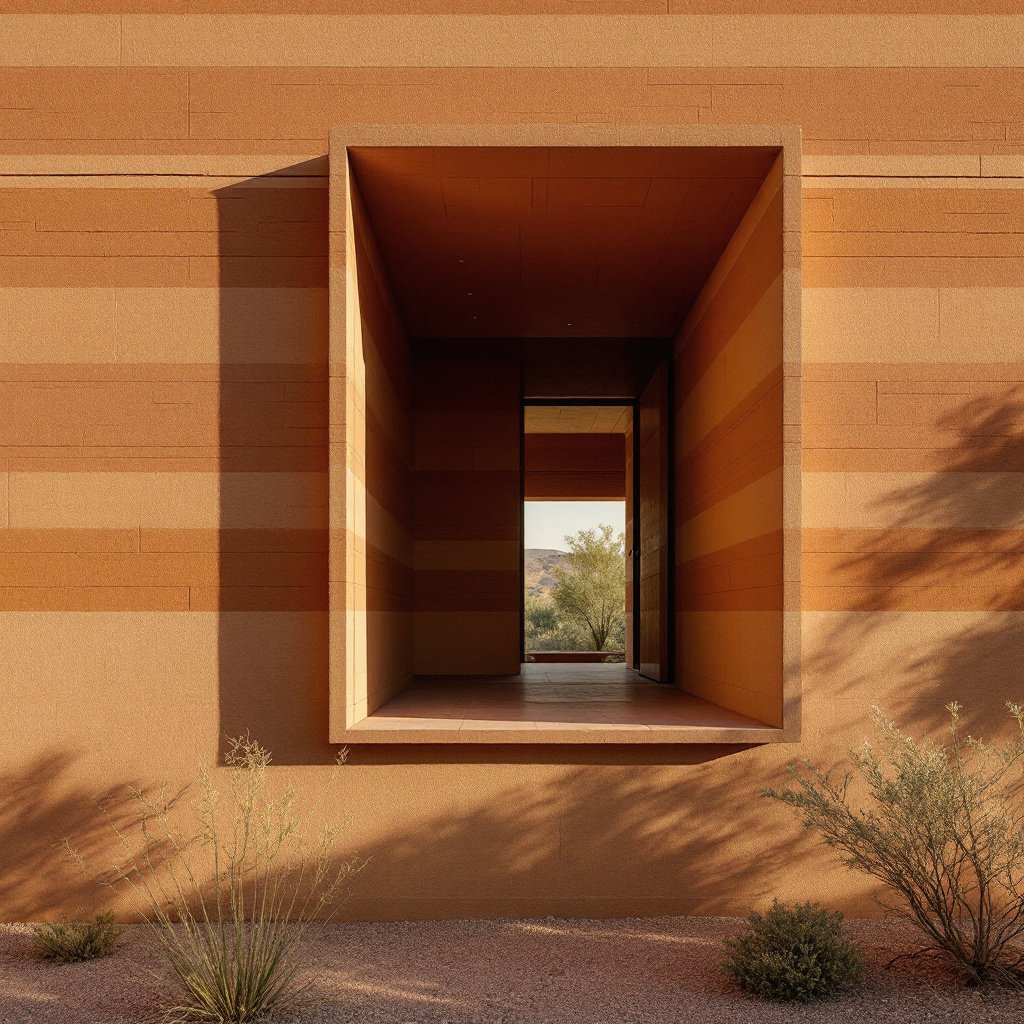
To the old formula, engineering adds: stabilization (a small cement or lime fraction that lets walls shrug off saturation), breathable siloxane sealers that shed liquid water while letting vapor escape (never film-forming paints, which trap moisture and cause the very damage they promise to prevent) and copings on every exposed wall top. Wet-climate walls in our Tennessee, Kentucky and Indiana practice get the full assembly as standard.
Water discipline is most of what separates centuries from decades in this craft. It's also, not coincidentally, the first thing we inspect when someone brings us a wall built by improvisers. See the whole process: the boots and hat are steps two and six.
To make the stakes concrete, walk through how an earthen wall actually dies. What follows is a composite (no particular project, just the sequence we've seen often enough to narrate from memory) and every step of it is a detailing decision, not a material flaw.
Year zero. A capable general contractor with no earthen experience wins the job. To save a pour, the wall starts at grade, no stem wall, or a token one flush with the finished landscape. The overhangs get trimmed in a budget meeting because eighteen inches "looks cleaner." Everyone photographs the beautiful new strata.
Year one. Every storm, rain hits the ground and splashes back against the bottom eight inches of the wall. The soil there cycles wet and dry dozens of times. Nothing visible happens yet, which is the trap: water damage in earth is a compounding loan, and the first year is interest-only.
Year two. The owner notices the base darkening after rain and asks for protection. Someone applies an elastomeric coating (a film-former) over a wall that hasn't fully dried. Liquid water is now slowed at the surface; vapor trying to leave the wall is stopped cold. Moisture accumulates behind the film exactly where the splash zone loads it.
Year three. A hard January. The saturated base freezes; water expands roughly 9% as it turns to ice, and pore by pore the compacted matrix near the surface is jacked apart. Come spring, the film blisters and sheds flakes of wall with it. The surface below is soft to a thumbnail.
Year five. The base of the wall has visibly receded, the classic "coving," an undercut notch running the wet side of the building. Repair now means cutting back to sound material, rebuilding the base in matched mix, adding the stem-wall protection it should have had, and stripping the coating everywhere. The fix costs multiples of what the original detailing would have.
Read the sequence again and notice what's absent: rain never once penetrated a properly detailed wall. Every failure was an invitation issued by a shortcut. That's the good news hiding in the forensics: this is an entirely preventable disease, and prevention is a checklist, not a miracle.
Here is the assembly, element by element, as we specify it. Skeptics are welcome to bring this table to any builder's meeting, including ours.
| Element | Specification | Why it matters |
|---|---|---|
| Stem wall | Concrete or stone base lifting earth well above finished grade, taller in snow country | Keeps the wall out of splash-back, snowmelt and ponding; chronic base moisture is the one condition earth can't tolerate |
| Site grading | Ground sloped away from the building on all sides; swales where the land argues | Water that never arrives needs no defense |
| Perimeter drainage | Foundation drains carrying roof and ground water clear of the footprint | Stops the hundred-year puddle from becoming a permanent tenant |
| Roof overhang | Deep eaves proportioned to wall height, exposure and climate | Keeps driving rain off the face; the wall's umbrella and the porch you wanted anyway |
| Coping | Metal, stone or concrete cap on every exposed wall top, with drip edges | Horizontal earth surfaces lose to standing water; copings retire the risk |
| Sill and head flashing | Flashed, sloped details at every window and penetration | Openings concentrate water; details must disperse it |
| Stabilization | Cement or lime at 5–10%, tuned to exposure and engineering | Lets the wall shrug off saturation events instead of softening |
| Sealer | Penetrating siloxane, vapor-open; refreshed every few years | Sheds liquid water while letting the wall breathe, never a film |
| Gutters and leaders | Sized generously, discharging away from the base | A roof concentrates thousands of gallons; direct them somewhere harmless |
Two notes on reading the table like a builder. First, the elements are a system, not a menu: the stem wall assumes the grading works, the sealer assumes the coping exists, and removing any single row quietly reassigns its job to a component that wasn't designed for it. Second, none of this is exotic or expensive relative to the wall it protects; the entire water assembly is a small fraction of wall cost, which makes skipping it the worst trade in the craft.
The sealer row deserves its own paragraph because it's where well-meaning owners do the most damage. Penetrating siloxane and silane treatments work by lining the pores of the wall a few millimeters deep with a water-repellent layer, liquid water beads and sheds, but the pore network stays open, so vapor moves through the wall freely in both directions. The wall stays dry the way a good raincoat keeps you dry: by shedding, not by suffocating.
Film-forming products (elastomerics, acrylics, and every paint aisle's promise of "waterproofing") do the opposite. They close the surface. Any moisture that enters the wall from anywhere else (the base, a hairline at a coping, ordinary seasonal vapor drive) is now trapped behind an impermeable skin, and it accumulates precisely where the film adheres. The failure mode is blistering, spalling and delamination, and it takes wall material with it when it goes. The rule is short enough to memorize: on earth, breathability is not a preference; it's the spec. If a product's marketing says "seals completely," it's describing the mechanism of the damage.
The formula is universal; the emphasis shifts by climate, and our practice happens to span both extremes. In Arizona, the enemy is the monsoon: brief, violent, frequently horizontal rain arriving after months of drought, hammering one or two exposures of the building. Detailing there leans on overhangs sized for wind-driven rain, robust stabilization on exposed faces, and the desert's own gift, walls dry out fast and completely between events. A single-mass wall with good boots and a good hat handles Sonoran weather as it has for centuries.
Tennessee, Kentucky and Indiana pose the opposite exam: roughly sixty inches of annual rain in the wetter country, delivered steadily, with long humid stretches where nothing dries quickly and real freeze-thaw seasons on top. There the assembly earns its keep, taller stem walls, deeper eaves, copings without exception, drainage designed rather than assumed, and stabilization percentages chosen so the wall goes into winter dry and stays serviceable even when it isn't. Wet-climate earth building is not harder than desert building; it is simply less forgiving of omissions. Which is exactly why we detail every wall, in every state, as if it were going to Tennessee.
Boots on, hat on, coat that breathes. Centuries follow.
