Sheridan sits at the foot of the Bighorns in old ranch country, and it is the market this company was built to serve. Estate-grade rammed earth for foothill sites, real winters and long horizons. From $1M.
Request a Consultation Call (307) 217-5491← Back to our Wyoming service area
We are named for the Bighorn Mountains, so it would be strange to be shy about this page. Sheridan is the town at the foot of that range, and the country between the mountain front and the plains east of town is, by a comfortable margin, the best argument for rammed earth anywhere in our service map. The land here has a specific character: foothill benches that step down out of the Bighorns, creek bottoms lined with cottonwoods, big-sky grassland running east, and a ranching culture more than a century deep that has always judged buildings by whether they are still standing.
That last part matters more than the scenery. Sheridan County’s architectural inheritance is heavy, honest and unfussy, stone and timber ranch headquarters, barns built by people who expected their grandchildren to use them, lodges that were designed to sit down into the ground rather than pose on top of it. Rammed earth belongs in that lineage without any translation. It is mineral, monolithic, quiet in color, and it ages the way stone ages, which is to say it does not so much weather as settle further into looking correct. A rammed earth house on a Sheridan bench does not announce itself as contemporary architecture. It reads as a building that has been given permission to be permanent.
And there is the operational point. Bighorn Rammed Earth is a Wyoming company, and northern Wyoming is a truck trip. Every part of a seven-figure custom build that depends on the builder physically being there (test pits, sample panels, formwork inspection, the mid-build conversations nobody schedules) is shorter, cheaper and better when the supervision chain does not involve an airport.
Sheridan punches far above its population. It is a county seat with a genuinely handsome historic main street, a long-standing horse and ranch culture, and a well-established second-home and relocation market drawn by the mountains, the polo and equestrian scene in and around Big Horn, and the same Wyoming fundamentals that shape the rest of the state, no state income tax and owner-friendly trust law. The result is a buyer profile that is unusual for a town this size: legacy ranch families, out-of-state owners who came for a season and stayed, and professionals who wanted a real town at the base of a real mountain range.
The estate product follows the land. Almost nothing interesting here happens on a subdivision lot. The work is on acreage, bench sites with the Bighorns filling the western window, creek-bottom parcels along Goose Creek and its tributaries, and ranch ground south toward Big Horn and Story where the tree line comes down to meet the grass. Buyers on that kind of ground are not shopping for square footage. They are shopping for a house that is worthy of the parcel, and they tend to be unusually receptive to the argument that a two-foot mineral wall is the correct response to a view like that.
Start with the fact that this is a real winter, not a decorative one. Northern Wyoming delivers cold that arrives early and stays, punctuated by chinook swings that can move the thermometer dramatically in a day. That combination (sustained cold plus violent swing) is the exact signature that separates a mass-and-insulation wall from a merely insulated one. Insulation determines how fast heat leaves. Mass determines when it moves. A house with both rides the swing instead of chasing it, and the mechanical system spends its life doing far less work than the outside temperature would suggest.
Then wind. The foothills funnel it, and sites that sit exposed on a bench take a working wind for much of the year. Rammed earth’s answer is the same everywhere in this state and it is not clever, it is structural: the wall is one continuous compacted mass with nothing to lift, drum, rattle or fatigue. Owners consistently describe the interior consequence first, inside two feet of earth, a hard blow becomes something you watch through the glass rather than listen to all evening.
Third, snow. Foothill and mountain-adjacent sites carry serious snow loads and long drift seasons, and spring melt in this country is an event rather than a gradual process. That drives roof engineering and grade detailing hard, which is the next section.
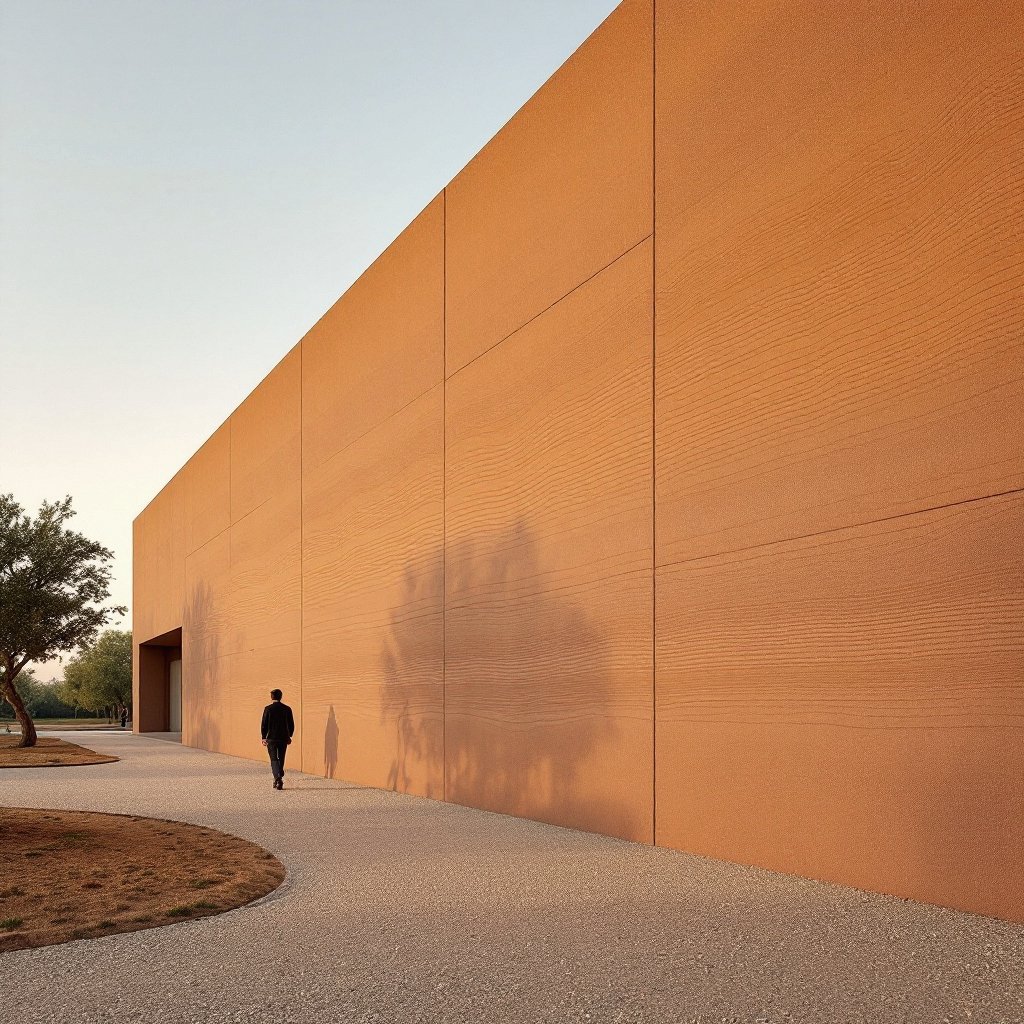
Ranch country has an old rule for anything that has to stand outside: give it good boots and a good hat. Every Wyoming wall we build is detailed to it. The boots are frost-depth concrete stem walls that lift the earthen mass well clear of grade, above splash, above the drift line, above the melt. The hat is the roof, with our standard twenty-four to thirty-six inch overhangs engineered to the site’s snow and wind loads, throwing weather clear of the wall faces.
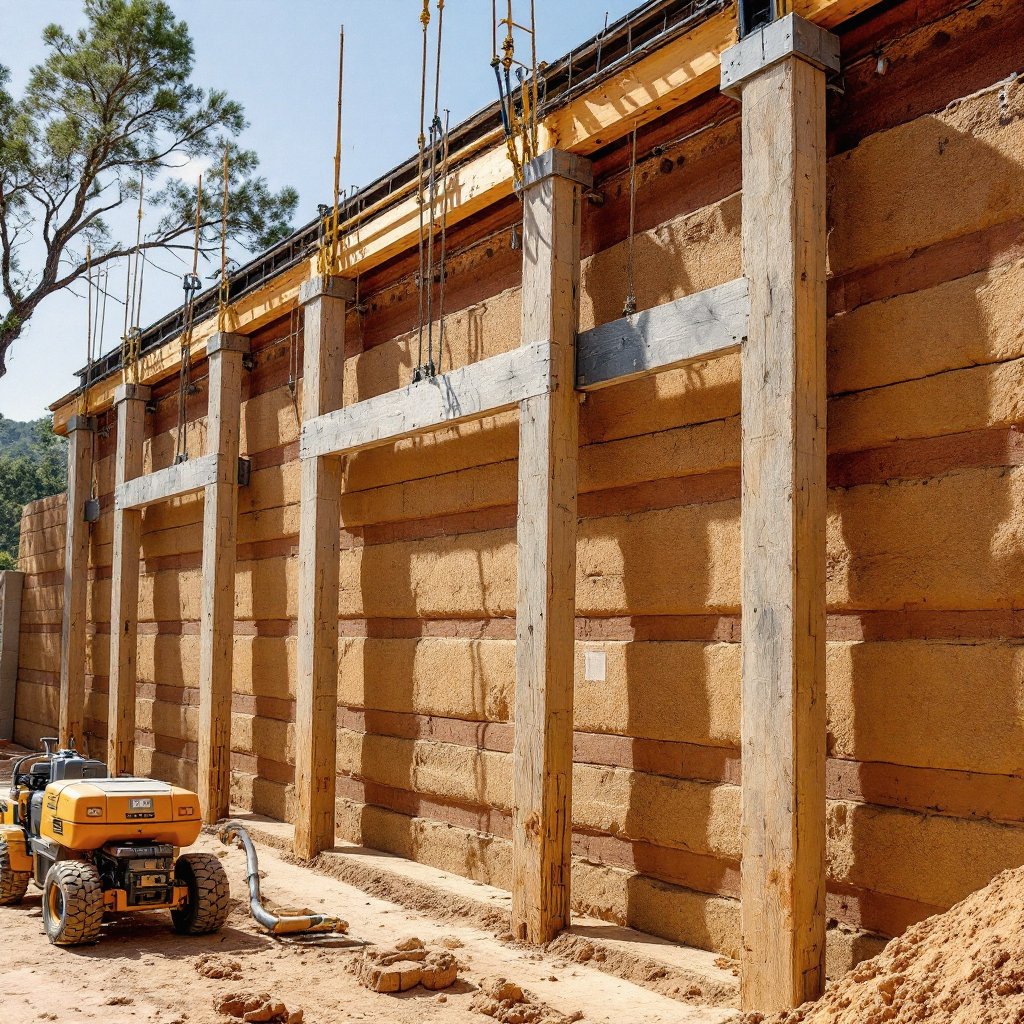
Between boots and hat, the openings do the fine work: heads, sills and reveals designed for precipitation that arrives sideways as often as it falls. The wall material is stabilized rammed earth, five to ten percent cement tuned to the blend and the exposure, compacted to a density that takes repeated freeze-thaw cycling without spalling. On foothill sites we pay particular attention to where snow will actually sit, drift patterns around a heavy building are predictable enough to design for, and designing for them is considerably cheaper than remediating them. The full discipline is written out in our essay on water detailing, and the cold-climate case is made in four-season climates.
Our standard assembly for northern Wyoming is the insulated-core double-wythe wall: two independent wythes of stabilized rammed earth around a continuous insulation core, so what you see inside and outside is unbroken strata while the wall section performs to modern four-season energy expectations. It is the same assembly we detail for Jackson Hole and for the high plains at Cheyenne, tuned here for foothill snow loads and the chinook swing.
Solar orientation is worth real design attention on these sites. The Bighorns dominate the western view, which is exactly where most clients instinctively want their glass, and where glass buys the least thermal benefit and the most winter heat loss. The productive move is to keep the view glazing deliberate and put the working glazing south, where the low winter sun can load the floors and mass walls through the afternoon and let them spend it back overnight. Done properly, the house gets the mountain and the mechanical savings both. Done carelessly, it gets the mountain and a heating bill.
| Question | The Sheridan answer |
|---|---|
| Wall assembly | Insulated-core double-wythe, 18–24" total, strata faces inside and out (our cold-climate, four-season standard |
| Snow & weather | Boots-and-hat detailing) frost-depth stem walls below, engineered 24–36" overhangs sized to foothill snow loads above, openings detailed for horizontal weather |
| Timeline | 16–26 months soil test to keys; ramming is warm-season work and the northern Wyoming season is shorter, which we schedule around honestly rather than optimistically |
| Budget | Turnkey $250–$450+ per square foot; $1M residential minimum; feature and landscape walls $50–$225 per square foot of face |
| Soil | Foothill and bottom ground differ sharply within a single parcel here; every site gets test pits before design, and imported blend corrects what the site lacks |
Sheridan is the market where our name is least abstract, and we treat it accordingly. This is a drive-to county for us, which shortens every feedback loop that decides whether a custom home lands on its promise. City and county each run their own development review, and rammed earth remains less familiar to northern Wyoming jurisdictions than it is in the Southwest, so we arrive with stamped structural and energy documentation prepared for exactly that conversation. A wall system that is non-combustible, visually quiet and demonstrably durable tends to make its own friends in review. The full numbers are in our cost guide, the estate-grade scope on our luxury homes page, and the vetting questions we hand to every client (including the ones they should ask us) in choosing a rammed earth builder.
What we are offering northern Wyoming, finally, is a match between material and temperament. This is country that respects things built heavy, built plainly and built to be handed down, where the most admired structure on a ranch is often the oldest one and nobody has ever been impressed by a wall you can put a fist through. Rammed earth is that sensibility in its own medium: local mineral ground, compacted lift by lift into something that treats a century as a reasonable planning horizon. Under a range that has been holding its line considerably longer, a house ought to think in the same units.
Request a Consultation Call (307) 217-5491
